Industry Focus · Industry Advancements
Antibiotics remain an essential treatment tool when bacterial disease outbreaks occur.
The industry's new direction is not to eliminate antibiotics, but to use them judiciously—
integrating diagnostics, vaccines, and herd health management through a strategic approach.
Compiled by: Sai Gon Vet
Updated: July 10, 2026
Reading time: approx. 7 minutes
 Environmental management and stock monitoring are the foundations of proactive disease prevention.
Three Key Takeaways
01 · TREATMENT
Antibiotics remain necessary for the timely treatment of bacterial infections in livestock and aquatic animals.
02 · RESPONSIBILITY
Concerns regarding antimicrobial resistance necessitate responsible usage, not the elimination of antibiotics.
03 · ROADMAP
Vaccination, diagnostics, and pond management are additional layers of protection that need to be appropriately implemented.
01
Antibiotics are not the problem — it is their inappropriate use that needs to change
In aquaculture, disease outbreaks can progress rapidly and cause significant losses.
When a bacterial infection is identified as the cause, timely treatment with appropriate antibiotics
remains crucial for safeguarding stock health, animal welfare, and economic viability.
The World Organisation for Animal Health (WOAH) affirms that antibiotic use cannot simply cease
when there is a valid medical reason for treatment. The correct objective is responsible use—only when necessary—
thereby preserving the drug's efficacy for cases where treatment is truly required.
[1]
For aquaculture producers, WOAH emphasizes that antimicrobial medicines are necessary in certain situations.
Treatment must be based on professional assessment, involve the use of products from authorized sources,
and adhere to treatment guidelines as well as withdrawal periods.
[2]
Use correctly when needed so that antibiotics remain effective when required.
A scientific review published in 2024, synthesizing studies from Southeast Asia
conducted between 2002 and 2023, identified Vietnam as the country with the highest number
of scientific reports on antimicrobial resistance in aquaculture in the region,
followed by Malaysia and Thailand. This does not confirm that Vietnam has the highest
rate of resistance, but it indicates that the issue is widely documented
and requires data-driven management.
[7]
Key distinction
Reducing unnecessary use is entirely different from delaying treatment
when the stock is suffering from a bacterial infection. The goal is
appropriate and timely treatment, not reduction at any cost.
02
From empirical treatment to evidence-based treatment
A crucial advancement in aquatic veterinary medicine is not necessarily
just the development of a more potent active ingredient. Greater value lies
in the ability to accurately identify the cause, select the right solution,
and monitor post-treatment efficacy.
| Approach requiring change |
Direction for improvement |
| Assessing disease primarily based on external signs |
Combining external signs, pond history, water quality, and laboratory testing |
| Using broad-spectrum antibiotics based on experience |
Selecting treatments based on the specific pathogen, epidemiological data, and antibiotic sensitivity |
| Constantly changing medications when immediate results are not seen |
Monitoring the response over an appropriate clinical timeframe |
| Treating only after an outbreak has occurred |
Combining disease prevention, early detection, and timely treatment |
| Failing to keep records of medication use |
Recording the product used, treatment duration, withdrawal period, and outcomes |
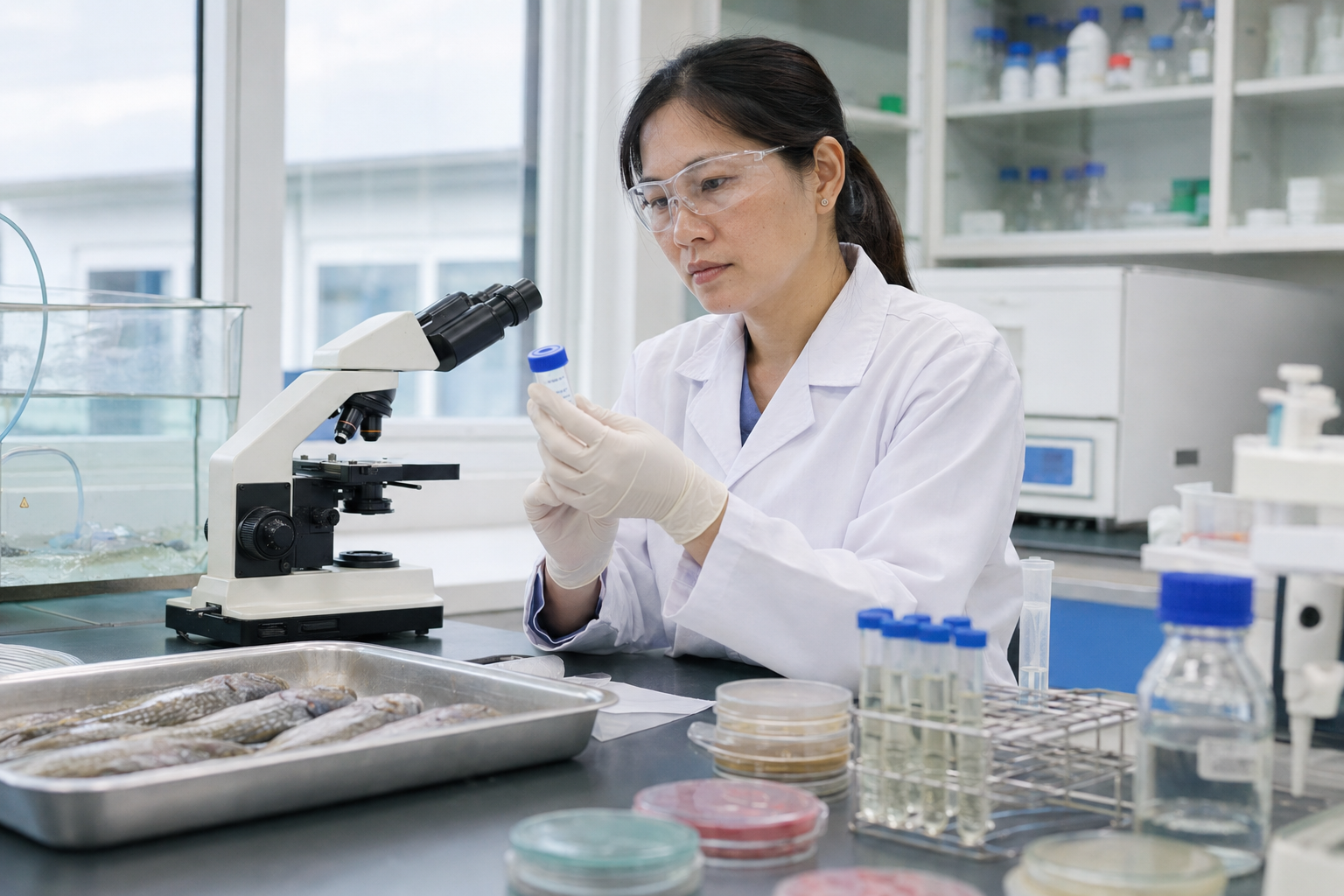 Diagnosis and testing facilitate the shift from experience-based drug selection
to evidence-based treatment.
Diagnosis and testing facilitate the shift from experience-based drug selection
to evidence-based treatment.
WOAH guidelines for aquatic animal health professionals emphasize
gathering stock history, conducting clinical assessments, sampling, and performing testing before
deciding on treatment. Antimicrobial susceptibility testing is particularly important when considering
classes of drugs of high importance.
[3]
03
Four innovation trends shaping the aquatic veterinary sector
TREND 01
Rapid diagnostics and antibiograms
Sampling, pathogen identification, and susceptibility assessment help reduce reliance on empirical drug selection.
Molecular diagnostic tools and epidemiological data are helping to shorten decision-making times.
TREND 02
Responsible use of antimicrobials
Antimicrobials are used when consistent with the diagnosis and in compliance with professional guidelines,
treatment durations, and withdrawal periods.
TREND 03
Vaccines and immune enhancement
Vaccines can prevent specific diseases and reduce the number of treatment episodes.
Application depends on the cultured species, the agent, the method of use, and the cost.
APPROACH 04
Proactive stock health management
Water quality, stocking density, nutrition, and biosecurity help reduce disease pressure,
but they do not replace the need for treatment when acute bacterial infections occur.
04
Vaccines are the right path, but not a shortcut
Vaccines play a crucial role in disease prevention and reducing the need for antibiotics.
However, aquatic vaccines are not yet available for every fish disease. Efficacy can vary
depending on the characteristics of the pathogen, the condition of the stock, the type of vaccine,
the method of administration, and production conditions.
Documents presented at the 2024 WOAH Asia-Pacific regional workshop
note that some vaccines remain costly, are difficult to use on a large scale, or do not yet
address emerging pathogens. Therefore, vaccines need to be developed and implemented
tailored to specific cultured species, diseases, and field conditions.
[4]
Practical perspective
Vaccines do not immediately replace the role of antibiotics. Before widespread adoption,
each solution must be evaluated based on the specific cultured species, the target pathogen,
application methods, production conditions, and economic viability.
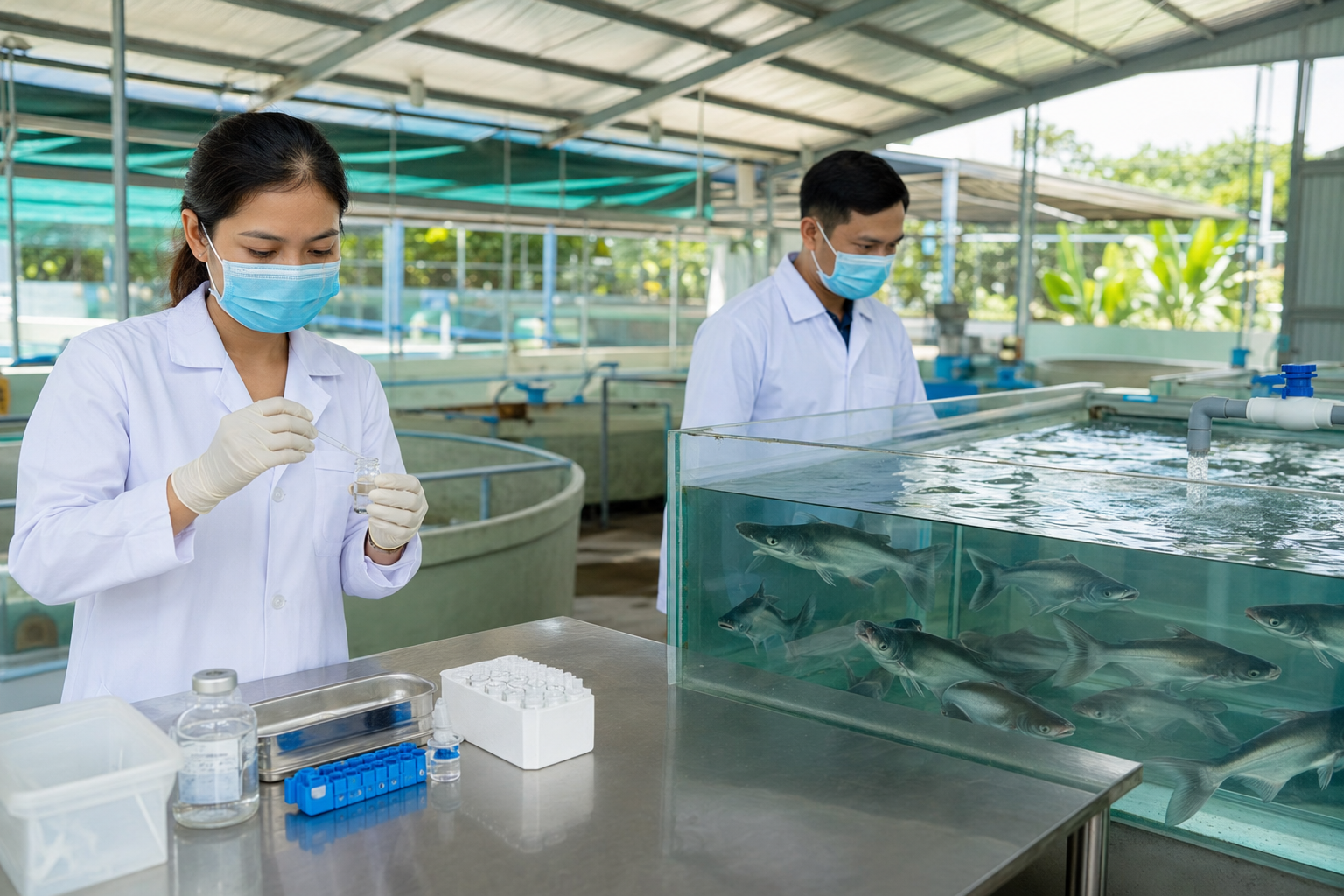 Vaccines must be evaluated based on the specific cultured species, the pathogen,
and actual production conditions.
Vaccines must be evaluated based on the specific cultured species, the pathogen,
and actual production conditions.
05
Four-layer health management model for farmed stocks
Instead of viewing antibiotics and vaccines as opposing options, the aquaculture industry
can establish an integrated management system comprising prevention, detection, treatment, and evaluation.
01
Prevention
Managing water quality, nutrition, stocking density, and biosecurity,
and using vaccines where appropriate.
02
Early detection
Monitoring the stock, recording abnormalities, assessing the environment,
and collecting samples to identify the cause.
03
Appropriate treatment
Selecting the suitable solution; Use antibiotics when necessary and based on professional grounds.
04
Monitoring
Track treatment response, medication history, and factors
requiring adjustment for the next production cycle.
Effective disease prevention reduces the need for treatment; proper treatment preserves antibiotic efficacy.
06
From research to practice in Vietnam
Projects on Pangasius and tilapia
A project supported by the International Centre for Antimicrobial Resistance Solutions (ICARS)
in Vietnam is evaluating licensed vaccines for Pangasius against
Edwardsiella ictaluri and Aeromonas hydrophila.
The project also pilots the IPRS farming system for tilapia to improve disease control.
The solutions are evaluated for effectiveness, feasibility,
and economic viability before scaling up is proposed.
[5]
This approach reflects a practical roadmap: starting with diseases caused by known pathogens,
piloting under production conditions, measuring results, and then scaling up.
At the national level, Vietnam’s Strategy on Antimicrobial Resistance Prevention and Control (2023–2030,
with a vision to 2045) focuses on surveillance, responsible antibiotic use,
and coordination across human, animal, and environmental health sectors using a One Health approach.
[6]
07
Roles of each link in the value chain
Farmers
- Regularly monitor the stock and the environment.
- Do not arbitrarily alter or combine medications.
- Record treatment history and outcomes.
Technical Expert
- Conduct comprehensive assessments before recommending treatment.
- Collect samples and utilize diagnostic data as needed.
- Monitor responses and make evidence-based adjustments.
Veterinary Business
- Provide high-quality products and clear information.
- Invest in research, diagnostics, and disease prevention solutions.
- Support the responsible use of medication.
Conclusion: Maintaining the proper role while expanding layers of protection
The future of aquatic veterinary medicine does not lie in two extreme choices:
continuing empirical antibiotic use or eliminating antibiotics entirely.
The sustainable path forward is to maintain antibiotics in their proper role as an essential treatment tool,
while simultaneously building additional layers of protection through diagnostics, vaccines, biosecurity,
and stock health management.
It is not about minimizing usage at all costs, but rather using products correctly when necessary and implementing effective disease prevention to reduce the need for them.
Professional Note:
The content of this article is intended to provide scientific information and does not replace
diagnoses, prescriptions, or treatment guidelines from veterinarians and aquatic animal health specialists.
The use of medications must comply with product specifications, current regulations, and withdrawal periods.
Compiled by Saigon Vet, July 2026.
The content has been synthesized and interpreted from the scientific and professional sources linked above;
it does not verbatim copy third-party articles. When citing, please credit saigonvet.vn.